
Beyond Fine Motor and Handwriting
How Occupational Therapy Can Help Bridge the Mental Health Gap
For decades, pediatric occupational therapy has often been associated with fine motor skills.
Handwriting. Cutting with scissors. Buttoning a shirt. Using classroom tools.
And yes—these skills are important.
But occupational therapy has always been about something much bigger:
Helping people participate in the activities that matter in their everyday lives.
And today, one of the biggest barriers to that participation isn’t always physical. It’s emotional.
Children Are Struggling—and We're Seeing It Everywhere .
We’re living in a time when children and families are navigating significant mental health and emotional challenges.
You see it in the classroom when a student refuses to work. You see it at home when a simple transition turns into a major meltdown. You see it during therapy when a child becomes overwhelmed by a task that feels too difficult.
At the same time, schools and families are often working with limited mental health resources, increasing demands, and professional burnout.
The result? Too many children are struggling, while the adults supporting them are stretched thin.
This creates an important opportunity for occupational therapy.
As OTs, we don’t need to become counselors or replace mental health professionals. But we can recognize how emotional well-being affects occupational performance—and use our existing skills to support emotional regulation, participation, and wellness.
Our profession has deep roots in mental health, and our holistic perspective gives us a unique lens for understanding the whole child.
So perhaps it’s time to expand the way we think about our role.

Pro Tips for Becoming an Advocate for Mental Health
1.) Recognize the Reality of the Mental Health Challenge
Before we can respond to a problem, we need to understand it.
Children and adolescents experience mental, emotional, and behavioral challenges at significant rates. This means that supporting emotional well-being isn’t a niche concern—it’s part of the everyday reality many pediatric professionals encounter.
And here’s something important to remember:
A child doesn’t need a formal diagnosis for emotional regulation to affect their ability to participate.
Think about the student who can’t transition between activities. The child who becomes overwhelmed by a small mistake. The student who shuts down when an assignment feels difficult. The child who refuses to participate because they’re afraid of getting something wrong.
These behaviors may be communicating that the child needs support with skills such as emotional regulation, flexibility, frustration tolerance, coping, or problem-solving.
Early recognition and support matter. As pediatric OTs, we are often in a unique position to notice these challenges because we see how they affect a child’s ability to participate in everyday occupations.
We don’t have to diagnose the problem to recognize that a child needs support.
2.) Look for the "Hidden" Stressors
When a child is struggling emotionally, there’s rarely just one explanation.
Children are influenced by their relationships, home environment, school experiences, sensory environment, sleep, routines, access to resources, and many other factors.
Adverse Childhood Experiences (ACEs), family stress, exposure to violence, bullying, social pressures, and other difficult experiences can all affect a child’s emotional well-being.
And today’s children are also growing up in a world filled with constant digital stimulation and social comparison.
For some children, these experiences can contribute to stress, anxiety, low self-esteem, or difficulty regulating emotions.
As OTs, our job isn’t to investigate every possible cause or solve every problem. Our job is to become curious.
Ask: What might be making this activity harder?
What demands is this child trying to manage?
What environmental factors might be contributing to the difficulty?
What skills does this child need in order to participate successfully?
When we understand the “why” behind a child’s struggles, we can move from frustration to advocacy. And that shift can make a tremendous difference.
When we understand the "why" behind a child's struggles, we can move from frustration to advocacy. And that shift can make a tremendous difference.
3.) Lean Into the Unique Strengths of Occupational Therapy
You might be wondering: “Is mental health really an OT’s job?”
The answer is: Mental health has always been part of occupational therapy.
OT is uniquely positioned to consider the connection between a person’s physical, emotional, cognitive, sensory, social, and environmental needs.
We understand how everyday occupations can influence well-being. Sleep affects participation. Daily routines affect regulation. Physical activity can support wellness. Sensory experiences can influence arousal and engagement. Relationships and environments can affect how safe and supported a child feels.
And through the therapeutic use of self, OTs can create relationships that help children feel understood, supported, and ready to participate.
This is the beauty of our profession. We don’t have to choose between physical skills and emotional well-being. We can address both.
A handwriting session can include emotional regulation. A fine motor activity can build frustration tolerance. A self-care routine can become an opportunity to practice flexibility. A transition can become a chance to teach coping skills.
The goal isn’t to abandon the OT goals we already have. It’s to make those goals more meaningful and functional by considering what the whole child needs to succeed.

4.) Help Bridge the Service Gap
There is a tremendous opportunity for school-based and pediatric OTs to bring emotional health and wellness into everyday practice.
And this doesn’t mean turning every therapy session into a counseling session. It means recognizing the emotional skills that support occupational participation.
Consider a student preparing for a difficult test. A child navigating friendship problems. A student struggling with the transition to middle school. A child who becomes overwhelmed when a task doesn’t go as planned.
These are real-life occupations and participation challenges.
We can support children by teaching skills such as:
- Identifying and labeling emotions
- Recognizing signs of stress in their bodies
- Practicing emotional regulation strategies
- Building frustration tolerance
- Developing flexibility and coping skills
- Using problem-solving strategies
- Asking for help appropriately
- Recovering from mistakes and setbacks
We aren’t replacing mental health professionals. We’re contributing our unique OT perspective to a team-based approach. And we’re helping children develop skills they can use in the places where they actually live, learn, play, and participate.
The Goal Isn't to Do More. It's to Think Bigger.
It can be easy to hear all of this and think: “I already have too much on my plate. How am I supposed to add mental health to my therapy sessions?”
But what if the answer isn’t adding another program, another worksheet, or another goal? What if it’s simply expanding the lens through which you view the child?
Instead of seeing handwriting refusal as a handwriting problem, consider whether frustration or anxiety is getting in the way.
Instead of seeing difficulty with transitions as simply a behavior problem, consider whether the child needs more support with flexibility and regulation.
Instead of seeing a meltdown as something that has interrupted your therapy session, consider whether it has become an opportunity to teach an important life skill.
That’s the shift. From task-focused to child-focused.
Mental Health Is Part of Occupational Performance
The most important takeaway is simple: Mental health matters.
It matters just as much as fine motor skills, handwriting, motor planning, and independence.
Because what good is a skill if a child can’t access it when they’re frustrated, overwhelmed, anxious, or discouraged?
When we help children develop emotional regulation skills, we aren’t simply helping them have a better day. We’re helping them build skills they can use throughout their lives.
Occupational therapists are life-skills specialists. And emotional regulation is one of the most important life skills a child can develop.
You already have the clinical knowledge, creativity, and heart to make a lasting difference. Now it’s time to recognize just how powerful that role can be.
Ready to Move Beyond "Just" Handwriting?
You don’t have to choose between being a skilled OT and becoming more confident in supporting children’s emotional well-being. You can do both.
And you don’t have to figure it all out on your own.
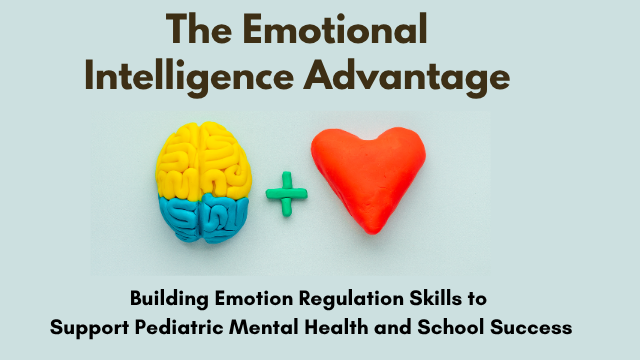
The EQ Advantage was created to help pediatric professionals build the knowledge, confidence, and practical strategies they need to intentionally support emotional intelligence and regulation skills in their everyday work.
Your OT toolbox is already powerful. Imagine what happens when you add EQ.
Take the next step in your professional growth and learn how to help children build emotional intelligence skills that can last a lifetime.
👉 Enroll in The EQ Advantage today.